
Magic Mushrooms
Microdosing Strains vs. Macro Dosing Strains: A Pharmacological Comparison
Sep
Microdosing Strains vs. Macro Dosing Strains: Understanding Potency, Alkaloids, and Intended Outcomes
Within both clinical research and informal mycology communities across Canada, the phrase “a mushroom is just a mushroom” has long been debunked. Just as different cannabis cultivars express distinct profiles of cannabinoids and terpenes, species and strains of the genus Psilocybe vary significantly in their chemical makeup.
When discussing psilocybin application—whether for sub-perceptual routine integration (microdosing) or deep, immersive psychological exploration (macrodosing)—understanding strain dynamics, alkaloid ratios, and potency predictability is essential.
Here is a detailed breakdown of how different Psilocybe cubensis strains and related species align with microdosing and macrodosing protocols.
1. The Chemistry Behind Strain Variation
To understand why certain strains are better suited for specific protocols, one must examine their underlying biochemistry. While psilocybin is the primary prodrug responsible for psychoactive effects, it is not the only active compound present in magic mushrooms.
Key Alkaloid Profiles
-
Psilocybin: The stable precursor that converts into psilocin in the liver.
-
Psilocin: The direct agonist of serotonin $5\text{-HT}_{2\text{A}}$ receptors, responsible for perceptual and cognitive shifts.
-
Baeocystin and Norbaeocystin: Minor alkaloids structurally similar to psilocybin that may modify the overall qualitative experience via the “entourage effect.”
-
Aeruginascin: A minor alkaloid studied for its potential role in modulating mood and preventing anxiety or dysphoria during onset.
Strains with high potency variance or extreme concentrations of psilocin tend to create rapid, intense experiences suited for macrodosing. Conversely, strains with highly stable, moderate alkaloid profiles allow for the precise, repeatable dosing required for microdosing.
2. Microdosing Strains: Prioritizing Predictability and Consistency
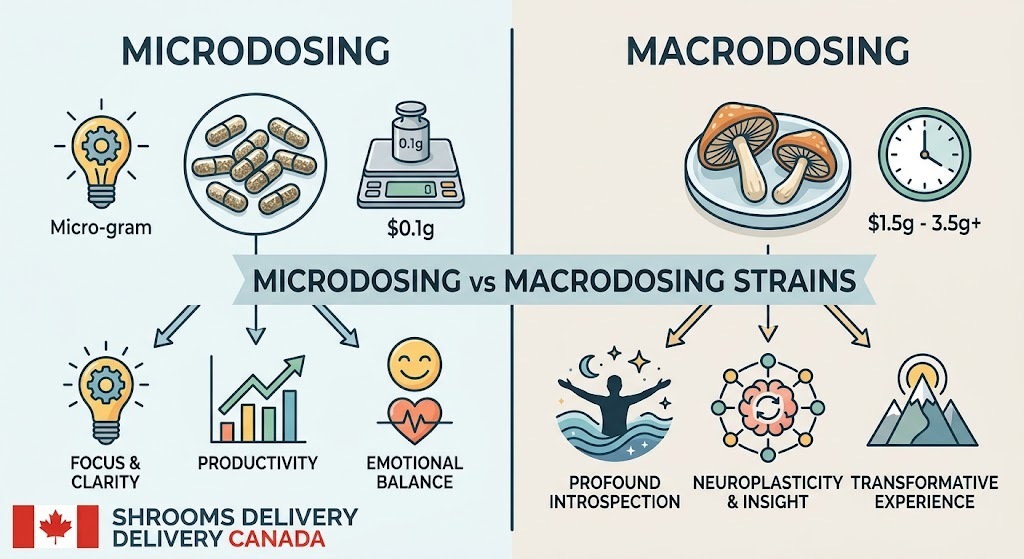
The core objective of a microdosing protocol (typically $0.05\text{g}$ to $0.25\text{g}$ of dried fungal material) is sub-perceptual cognitive enhancement. The user seeks benefits such as heightened focus, improved emotional regulation, and subtle neuroplasticity without experiencing perceptual distortions or cognitive impairment.
+----------------------------------------------------------------------------+
|                       IDEAL MICRODOSING STRAIN TRAITS                      |
+----------------------------------------------------------------------------+
|  1. MODERATE POTENCY: Avoids accidental over-intoxication.                 |
|  2. BATCH CONSISTENCY: Uniform distribution of alkaloids throughout caps. |
|  3. STABLE SHELF-LIFE: Minimal degradation of psilocybin over time.       |
|  4. BALANCED ALKALOID RATIO: Smoother, less volatile onset profile.        |
+----------------------------------------------------------------------------+
Top Strains Commonly Selected for Microdosing
Golden Teacher (Psilocybe cubensis)
Golden Teacher is widely considered the benchmark strain for microdosing protocols. It offers a moderate, highly predictable concentration of psilocybin (typically averaging around $0.6\%$ to $0.8\%$ total alkaloid weight). Its consistent genetics make it easier to calibrate tiny, sub-perceptual doses reliably.
B+ Strain (Psilocybe cubensis)
Known for its versatility and gentle onset profile, B+ is another staple for daily or alternate-day microdosing schedules (such as the Fadiman Protocol). Users frequently report an even distribution of cognitive clarity with minimal physical heaviness.
Costa Rican (Psilocybe cubensis)
Originating from warm coastal environments, Costa Rican strains typically exhibit a balanced alkaloid balance, making them popular among individuals seeking emotional grounding and subtle mood stabilization without sudden spikes in intensity.
3. Macrodosing Strains: Seeking Potency, Depth, and Transformation
A macrodose protocol (ranging from $1.5\text{g}$ for a moderate experience to $3.5\text{g}+$ for a deep therapeutic session) aims to temporarily down-regulate the brain’s Default Mode Network (DMN). This state allows for profound introspection, emotional processing, and heightened neuroplasticity.
For macrodosing, predictability is still valuable, but higher alkaloid concentration and unique psychoactive dynamics are often prioritized.
| Strain / Variant | Average Potency Level | Primary Experience Characteristics | Best Suited Protocol |
| Golden Teacher | Moderate ($0.6\% – 0.8\%$) | Gentle onset, reflective, manageable introspective depth | Beginner Macrodose / Microdose |
| Penis Envy (PE) | High to Extreme ($1.5\% – 2.2\%$) | Rapid onset, intense visual/perceptual shifts, deep ego-dissolution | Advanced Therapeutic Macrodose |
| Blue Meanie (P. cyanescens) | Very High ($1.2\% – 1.8\%$) | Heavy physical sensations, vivid sensory alterations | Experienced Macrodose |
| Amazonian | Moderate-High ($0.8\% – 1.2\%$) | Energetic, highly visual, mood-elevating peak | Standard Macrodose |
High-Potency Strain Considerations
Penis Envy (PE) and Mutations
Penis Envy variants (including Albino Penis Envy, or APE) regularly test significantly higher in psilocybin and psilocin concentration compared to standard P. cubensis cultivars—sometimes up to two to three times as potent by dry weight. Because of this extreme concentration, using Penis Envy for a microdose requires precise volumetric scaling or micro-gram digital scales to avoid accidentally triggering a perceptual trip.
Wood-Loving Species (Psilocybe cyanescens / Psilocybe azurescens)
Unlike dung- or grain-dwelling P. cubensis, wood-loving species contain drastically higher overall alkaloid content. They are almost exclusively reserved for macrodosing due to their intensity and potential to induce temporary muscle weakness (referred to as “wood-lovers paralysis” in anecdotal literature), making them unsuitable for daytime functional microdosing.
4. Shrooms Delivery Canada Frequently Asked Questions
Can you use high-potency macrodosing strains like Penis Envy for microdosing?
Yes, but with extreme caution. Because Penis Envy is significantly more potent than standard strains like Golden Teacher, you must reduce your microdose quantity accordingly (often by $50\%$ or more, down to $0.025\text{g} – 0.05\text{g}$) to remain in the sub-perceptual range.
What is the main difference between microdosing and macrodosing strains?
The main difference lies in potency consistency and alkaloid concentration. Microdosing strains generally feature moderate, highly stable alkaloid levels that allow for precise daily dosing without perceptual disruption. Macrodosing strains often feature higher total psilocybin/psilocin levels designed to induce full psychoactive states.
How do different psilocybin strains affect the brain differently?
Different strains contain varying ratios of active compounds—including psilocybin, psilocin, baeocystin, and norbaeocystin. This subtle variance, known as the entourage effect, can alter the speed of onset, physical body sensations, and emotional intensity of the experience.
Why is Golden Teacher considered the best strain for beginners and microdosing?
Golden Teacher is widely favored for microdosing due to its stable genetic lineage and moderate, reliable alkaloid profile. This consistency minimizes the risk of taking an unexpectedly strong dose during work or daily activities.
5. Summary of Harm Reduction and Dosing Precision
Choosing between microdosing and macrodosing strains ultimately comes down to matching the strain’s chemical profile to your specific wellness intentions.
-
For Microdosing: Choose strains with moderate, consistent potency profiles (e.g., Golden Teacher, B+). Use precision $0.01\text{g}$ digital scales or pre-measured capsule formulations to maintain sub-perceptual boundaries.
-
For Macrodosing: Respect the potency of high-strength cultivars (e.g., Penis Envy). Always establish a safe set, setting, and sober support system before engaging with higher therapeutic doses.
