
Magic Mushrooms
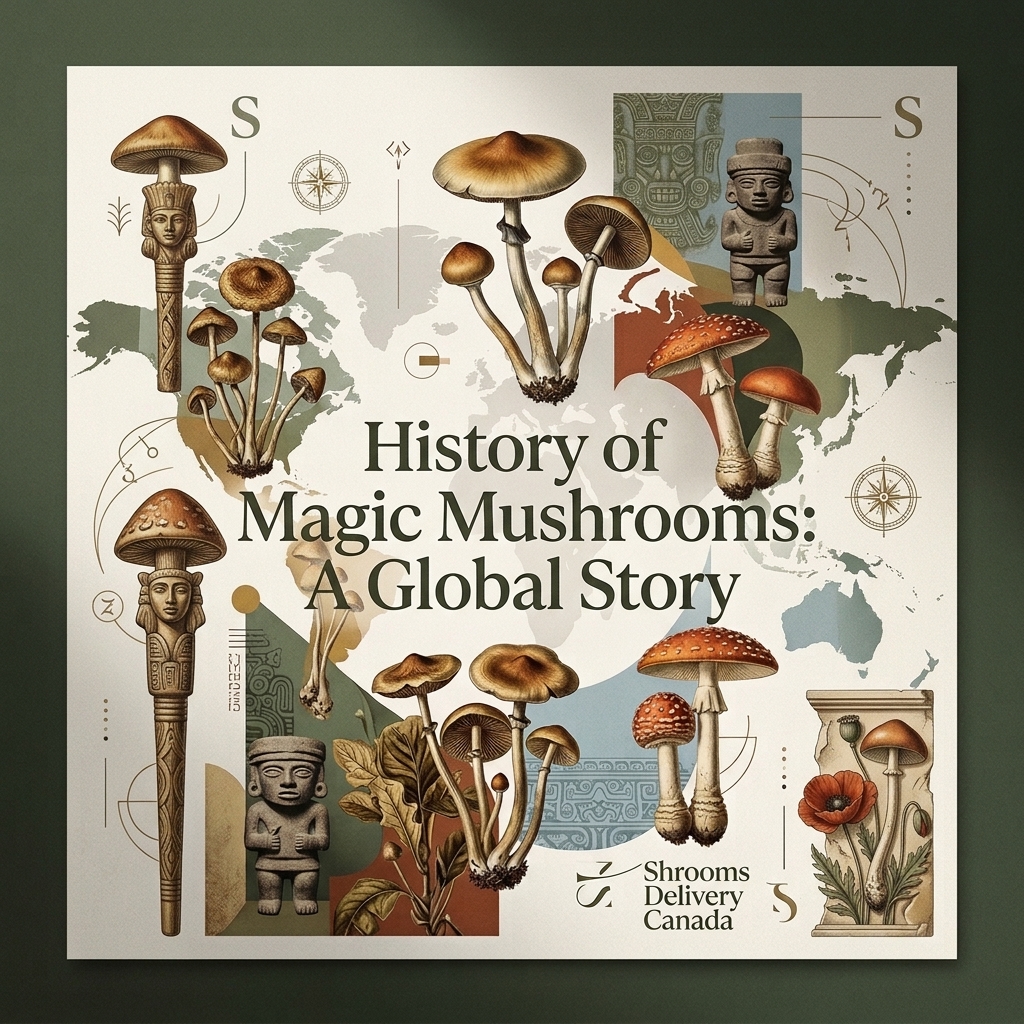
History of Magic Mushrooms: A Global Story | Shrooms Delivery Canada
Jul
The History of Magic Mushroom Use Around the World
TL;DR: Magic mushrooms have been used by humans for at least 9,000 years, with evidence spanning Africa, Mesoamerica, Europe, and Asia. Revered in ancient spiritual ceremonies and rediscovered by Western science in the mid-20th century, psilocybin is now the subject of serious clinical research. In Canada, magic mushrooms remain a Schedule III controlled substance under the Controlled Drugs and Substances Act, with limited legal access available through Health Canada’s Special Access Program.
Few subjects in human history are as fascinating—or as widely misunderstood—as the story of magic mushrooms. Long before they became a topic of scientific papers and policy debates, these fungi were woven into the spiritual fabric of civilisations across the globe. Shamans held them in ceremonial hands. Ancient artists painted them on cave walls. Healers brewed them into sacred teas.
That history spans at least nine millennia and touches every inhabited continent. And today, as researchers, policymakers, and everyday Canadians re-examine psilocybin with fresh eyes, understanding where magic mushrooms come from—and how they’ve been used matters more than ever.
This blog post traces that remarkable journey from prehistoric rock art to modern clinical trials. It covers what the archaeological record actually tells us, how various cultures understood and used these mushrooms, what happened when the Western world “discovered” them in the 1950s, and what all of this means for Canadians right now. Whether you’re curious about the history, the science, or the legal landscape, you’ll find clear, fact-grounded answers here.
One note before we begin: this post is written for educational purposes. It does not encourage illegal activity. Magic mushrooms remain a controlled substance in Canada, and the legal context is addressed in detail below.
What Are Magic Mushrooms, Exactly?
Magic mushrooms are fungi that contain psilocybin, a naturally occurring psychoactive compound. When ingested, the body converts psilocybin into psilocin, which interacts with serotonin receptors in the brain to produce altered perceptions, vivid hallucinations, and profound shifts in consciousness.
There are over 200 known species of psilocybin-containing mushrooms, found on every continent except Antarctica. The most commonly referenced species belong to the genus Psilocybe, though other genera also contain psilocybin in varying concentrations.
History of Magic Mushrooms: A Global Story | What Is the Earliest Known Use of Magic Mushrooms?
The earliest archaeological evidence of human engagement with psychoactive mushrooms comes from Tassili n’Ajjer, a UNESCO World Heritage Site in the Algerian Sahara. Cave paintings at this site, dating back approximately 7,000 to 9,000 years, depict human figures holding mushroom-like objects, with lines extending from those objects toward the heads of the figures—interpreted by researchers as symbolising the mental or spiritual effects of the fungi.
The U.S. Forest Service formally acknowledges Tassili n’Ajjer as “the oldest known petroglyph depicting the use of psychoactive mushrooms.” Ethnobotanist Terence McKenna described the paintings in his book Food of the Gods as showing “shamans dancing with fists full of mushrooms and also with mushrooms sprouting out of their bodies.” Separately, researcher Giorgio Samorini documented a key figure holding a mushroom-like object, with parallel lines connecting it to the dancer’s head—a motif he interpreted as representing the “universal mental value induced by hallucinogenic mushrooms.”
A 2012 paper in Acta further suggested the depicted species may be Psilocybe mairei Singer, a mushroom native to the region.
This is compelling evidence, though it’s worth noting that archaeological interpretation of ancient art always carries some degree of uncertainty. What is clear is that the relationship between humans and psychoactive fungi is ancient—far older than written language.
How Did Mesoamerican Cultures Use Magic Mushrooms?
The Aztec Tradition of Teonanácatl
Among the most thoroughly documented uses of magic mushrooms in history comes from Mesoamerica, where evidence of ritual mushroom use dates back to at least 1000 BCE. The Aztecs called psilocybin mushrooms teonanácatl—a Nahuatl word meaning “flesh of the gods.” That name alone conveys the reverence with which these fungi were regarded.
Teonanácatl was consumed during religious ceremonies, healing rituals, and divination practices. Priests and spiritual leaders believed the mushrooms opened a direct channel to deities and ancestral spirits. These were not casual gatherings. They took place within temples and sacred sites, following elaborate protocols designed to honour the power of the fungi.
When Spanish colonisers arrived in the 16th century, they were both fascinated and disturbed by what they witnessed. Spanish chroniclers documented the ceremonies, though they typically filtered their observations through a European Christian lens that characterised the rituals as devil worship. Despite sustained efforts to suppress these practices, Aztec and Mazatec healers preserved the tradition in secret, passing it down through generations.
Ancient Mushroom Art and Sculptures
Archaeological digs throughout Mesoamerica have unearthed mushroom-shaped sculptures and figurines dating back thousands of years. These artefacts, many of which appear to depict Psilocybe species, signal that magic mushrooms held a central role not just in ceremony, but in the cultural and artistic life of these civilisations. The Maya, like the Aztecs, also incorporated sacred mushrooms into their spiritual traditions and left behind visual records of their use.
What Evidence Exists for Magic Mushroom Use in Africa and Europe?
Africa: The Rock Art Connection
Beyond Tassili n’Ajjer, the broader archaeological record suggests that certain African tribes incorporated psychoactive mushrooms into healing rituals and communal spiritual practices. Shamans guided these experiences, using altered states of consciousness to seek connection with the spirit world and facilitate healing within their communities.
The iconography at Tassili remains the most striking piece of physical evidence. The “mushroom shaman” figures there have become iconic within ethnobotanical research, acknowledged by scholars as representing some of the earliest known depictions of ritual psychoactive use in human history.
Europe: Eleusinian Mysteries and Celtic Traditions
European cultures were not entirely removed from psychoactive mushroom traditions, though the evidence here is more interpretive. Ancient Celtic and Norse societies are thought by some historians to have incorporated mind-altering substances, possibly including mushrooms, into their shamanic and druidic practices.
The most intriguing European connection involves the Eleusinian Mysteries of ancient Greece—a series of sacred rites held annually in honour of Demeter and Persephone. Participants described profoundly transformative experiences during the ceremonies. Some researchers have proposed that the kykeon, a ritual drink consumed during the Mysteries, may have contained psychoactive compounds, possibly psilocybin or ergot-derived substances. This remains a contested hypothesis, but it is one that serious classical scholars have engaged with at length.
Did Ancient Asian Cultures Use Psychoactive Mushrooms?
Siberian Shamanism and the Fly Agaric
In Asia, the history of ritual mushroom use is closely associated with Amanita muscaria, the iconic red-and-white fly agaric mushroom. Distinct from Psilocybe species, Amanita muscaria contains different psychoactive compounds—muscimol and ibotenic acid—but it served a similar ceremonial role across Siberia and much of the north-Eurasian forest belt for centuries, and likely millennia.
According to research from the Penn Museum, indigenous Siberian peoples used Amanita muscaria as an entheogen in shamanic rituals, entering altered states to communicate with spirits and navigate the unseen world. This tradition persisted across multiple indigenous groups stretching from Siberia into parts of northern Europe.
Japan and East Asia
Psilocybin mushrooms feature less prominently in the documented history of East Asia, though the waraitake (“laughing mushroom”) appears in 11th-century Japanese literature, specifically in the Konjaku Monogatari, where it is described as causing involuntary laughter and disorientation in those who consumed it. This suggests awareness of psychoactive fungi in Japanese culture, even if formal ceremonial use was not as systematically documented as in Mesoamerica.
How Were Magic Mushrooms Rediscovered by the Western World?
R. Gordon Wasson and the Life Magazine Moment
The story of magic mushrooms’ entry into Western consciousness begins with a bank executive and amateur mycologist named R. Gordon Wasson. In 1955, Wasson and his wife Valentina travelled to the remote Mazatec village of Huautla de Jiménez in southern Mexico, where they were invited to participate in a traditional velada—a sacred nighttime mushroom ceremony—led by the renowned healer María Sabina.
Wasson’s experience was, by his account, deeply transformative. He brought back mushroom samples, and in May 1957 he published an article in Life magazine titled “Seeking the Magic Mushroom,” introducing the concept of psilocybin-assisted ritual to an audience of millions of Americans. The article is widely credited as the cultural spark that ignited Western fascination with psychedelics.
Albert Hofmann Isolates Psilocybin
Shortly after Wasson’s journey, Swiss chemist Albert Hofmann—already famous for synthesising LSD in 1938—isolated and chemically identified psilocybin for the first time in 1958. Working with mushroom samples brought back from Mexico, Hofmann’s synthesis made it possible for researchers to study the compound in controlled settings, separating it from the ceremonial context in which it had always existed.
This was a critical turning point. Psilocybin could now be manufactured, measured, and studied. The implications for both science and culture were enormous.
What Happened During the Psychedelic Era of Research?
Harvard, Timothy Leary, and the Controversy
The 1960s brought both genuine scientific inquiry and significant controversy. Harvard psychologist Timothy Leary conducted some of the earliest formal studies of psilocybin’s psychological effects, exploring its potential as a tool for personal and therapeutic transformation. The “Harvard Psilocybin Project,” which ran from 1960 to 1962, produced findings that suggested real therapeutic potential—but Leary’s increasingly evangelistic promotion of psychedelics beyond the lab contributed to a cultural and political backlash.
In 1970, the U.S. government classified psilocybin as a Schedule I substance under the Controlled Substances Act, effectively halting most research for decades. Canada and other Western nations followed with similarly restrictive legislation.
The Return of Serious Science
Research did not disappear entirely, but it moved to the margins for roughly thirty years. The modern resurgence began in earnest in the late 1990s and early 2000s, driven by institutions including Johns Hopkins University and the Beckley Foundation, led by Amanda Feilding, which has now accumulated over 25 years of psychedelic research.
Clinical trials have since demonstrated meaningful results across several mental health conditions. Psilocybin-assisted therapy has shown particular promise for treatment-resistant depression, with evidence suggesting it helps “reset” patterns of rigid negative thinking in the brain. Ongoing studies are also examining psilocybin’s potential in treating anxiety, PTSD, and substance use disorders.
What Is the Current Conversation About Magic Mushrooms in Canada?
Canada sits at an interesting intersection of growing public interest and firm federal law. A 2023 report found that 5.9% of Canadians reported using psychedelics in 2023—a 195% increase compared to 2019 (Therapsil, 2023). Magic mushroom dispensaries operate openly in cities like Vancouver and Toronto, creating a public impression that psilocybin may be legal. That impression is inaccurate and potentially dangerous.
At the same time, there is genuine and well-supported public appetite for change. A 2021 survey found that 82% of Canadians supported legal access to psilocybin-assisted therapy for patients with end-of-life illness (Psychedelic Alpha, 2021).
What Is the Legal Status of Magic Mushrooms in Canada?
Psilocybin Is a Schedule III Controlled Substance
Under Canada’s Controlled Drugs and Substances Act (CDSA), psilocybin and psilocin are classified as Schedule III controlled substances. This means that possession, trafficking, and production of magic mushrooms are illegal across all Canadian provinces and territories without specific authorisation from Health Canada. Federal law applies uniformly, regardless of what local enforcement priorities may suggest.
Criminal penalties are serious:
- Possession: Up to $1,000 fine and/or six months in prison for a first offence (summary conviction); greater penalties apply for indictable offences or repeat offences
- Trafficking (selling): Up to 10 years in prison
- Production (growing): Up to 10 years in prison
The grey market of dispensaries operates due to inconsistent local enforcement—not because the law has changed. RCMP seizures of psilocybin, including a notable Nova Scotia operation, confirm that criminal enforcement remains a real possibility.
Legal Pathways That Do Exist
There are narrow, strictly regulated exceptions:
- Health Canada’s Special Access Program (SAP): Allows physicians to request psilocybin access for patients with serious or life-threatening conditions where conventional treatments have failed. As of February 2024, 176 Canadians had been authorised to access psilocybin through the SAP, with Health Canada approving approximately 78% of applications (PMC/NCBI, 2024).
- Clinical Trials: A 2023 report identified four ongoing clinical trials in Canada investigating psilocybin for various mental health conditions (Lexpert, 2023).
- Alberta’s Provincial Regulation: In January 2023, Alberta became the first Canadian province to regulate the medicinal use of psychedelics, allowing licensed psychiatrists to administer them under specific clinical protocols (PMC/NCBI, 2023).
These pathways exist, but they are restricted to medical supervision and are not available to the general public.
What Should You Know About Safety and Harm Reduction?
Regardless of the legal landscape, harm reduction is important. If you or someone you know is considering or has used psilocybin, here is what current research and public health guidance suggest (Government of Canada; Drug Free Kids Canada, 2025):
- Know your risk profile. People with a personal or family history of schizophrenia, psychosis, or serious heart conditions face heightened risks and should avoid psilocybin use entirely.
- Never mix with other substances. Combining psilocybin with alcohol or other drugs significantly increases the risk of adverse reactions.
- Set and setting matter. Research consistently shows that environment and mental state strongly influence outcomes. An unsafe or distressing setting increases the likelihood of a difficult experience.
- Use around trusted people. If psilocybin is consumed, being in the company of trusted, sober individuals reduces risk.
- Know the signs of a bad trip. Extreme paranoia, panic attacks, terrifying hallucinations, and psychotic episodes are possible, particularly in new or heavy users. If someone appears to be in distress or danger, contact emergency medical services.
- Be aware of misidentification risks. There are over 200 species of magic mushrooms, and some can be mistaken for poisonous species. Misidentification has led to hospitalisations.
- Never inject mushrooms. Injection of psilocybin can cause septic shock and multiple organ failure.
Psilocybin is not considered physically addictive, and there is no evidence that it causes physical dependence. However, tolerance develops rapidly with repeated use—sometimes within days—requiring breaks in use to restore sensitivity.
Frequently Asked Questions About Magic Mushrooms
What are magic mushrooms, and why do people use them?
Magic mushrooms are fungi containing psilocybin, a naturally occurring psychoactive compound. Historically, people used them for spiritual, healing, and ceremonial purposes. Today, some people use them recreationally or to self-manage mental health challenges. Psilocybin is also being studied clinically for its potential to treat depression, anxiety, PTSD, and addiction.
How long have humans been using magic mushrooms?
The earliest known evidence of psychoactive mushroom use dates back approximately 7,000 to 9,000 years, based on cave paintings at Tassili n’Ajjer in Algeria. Documented ceremonial use in Mesoamerica dates to at least 1000 BCE, and Siberian shamanic traditions involving psychoactive mushrooms are considered to stretch back many millennia.
Are magic mushrooms legal in Canada?
No. Psilocybin and psilocin are Schedule III controlled substances under Canada’s Controlled Drugs and Substances Act. Magic mushrooms are illegal to possess, sell, or grow in Canada without specific Health Canada authorisation. Open storefronts in some cities operate in a legal grey area due to inconsistent enforcement, but this does not mean the law has changed. Penalties include up to 10 years in prison for trafficking or production.
Can Canadians legally access psilocybin for medical reasons?
Yes, through very limited channels. Health Canada’s Special Access Program allows physicians to apply for psilocybin access for patients with serious conditions where other treatments have failed. As of February 2024, 176 Canadians had been authorised under this programme. Psilocybin is also available through a small number of approved clinical trials across Canada.
What did R. Gordon Wasson contribute to magic mushroom history?
R. Gordon Wasson was one of the first Westerners to participate in a traditional psilocybin ceremony in Mexico. In 1957, he published an account in Life magazine that introduced millions of North American readers to the concept of ritual magic mushroom use. His writing is widely credited with sparking Western scientific and cultural interest in psilocybin.
What are the risks of using magic mushrooms?
Risks include “bad trips” characterised by extreme paranoia, panic, and terrifying hallucinations; adverse interactions with other drugs or alcohol; psychological risks for people with pre-existing conditions like psychosis or schizophrenia; cardiovascular risks for those with heart conditions; and the danger of misidentifying toxic mushroom species. These risks are meaningfully reduced in structured, medically supervised settings.
What mental health conditions is psilocybin being studied for?
Current clinical research is investigating psilocybin’s potential to treat treatment-resistant depression, anxiety (particularly in end-of-life contexts), PTSD, and substance use disorders including addiction to alcohol and tobacco. Promising results have emerged from institutions including Johns Hopkins University and the Beckley Foundation, though psilocybin is not yet approved as a therapeutic agent in Canada outside of specific exemptions.
Is psilocybin addictive?
According to current evidence, psilocybin does not cause physical or psychological dependence. However, the body builds tolerance to psilocybin quickly—sometimes within just a few days of repeated use. This means the desired effects diminish rapidly, requiring rest periods between uses to restore sensitivity.
Buy Cocaine Online Canada
Buy Cocaine Online Canada
Buy Cocaine Online Canada
Buy Cocaine Online Canada
Buy Cocaine Online Canada
Buy Cocaine Online Canada
Buy Cocaine Online Canada
Buy Cocaine Online Canada
